Card Fraud
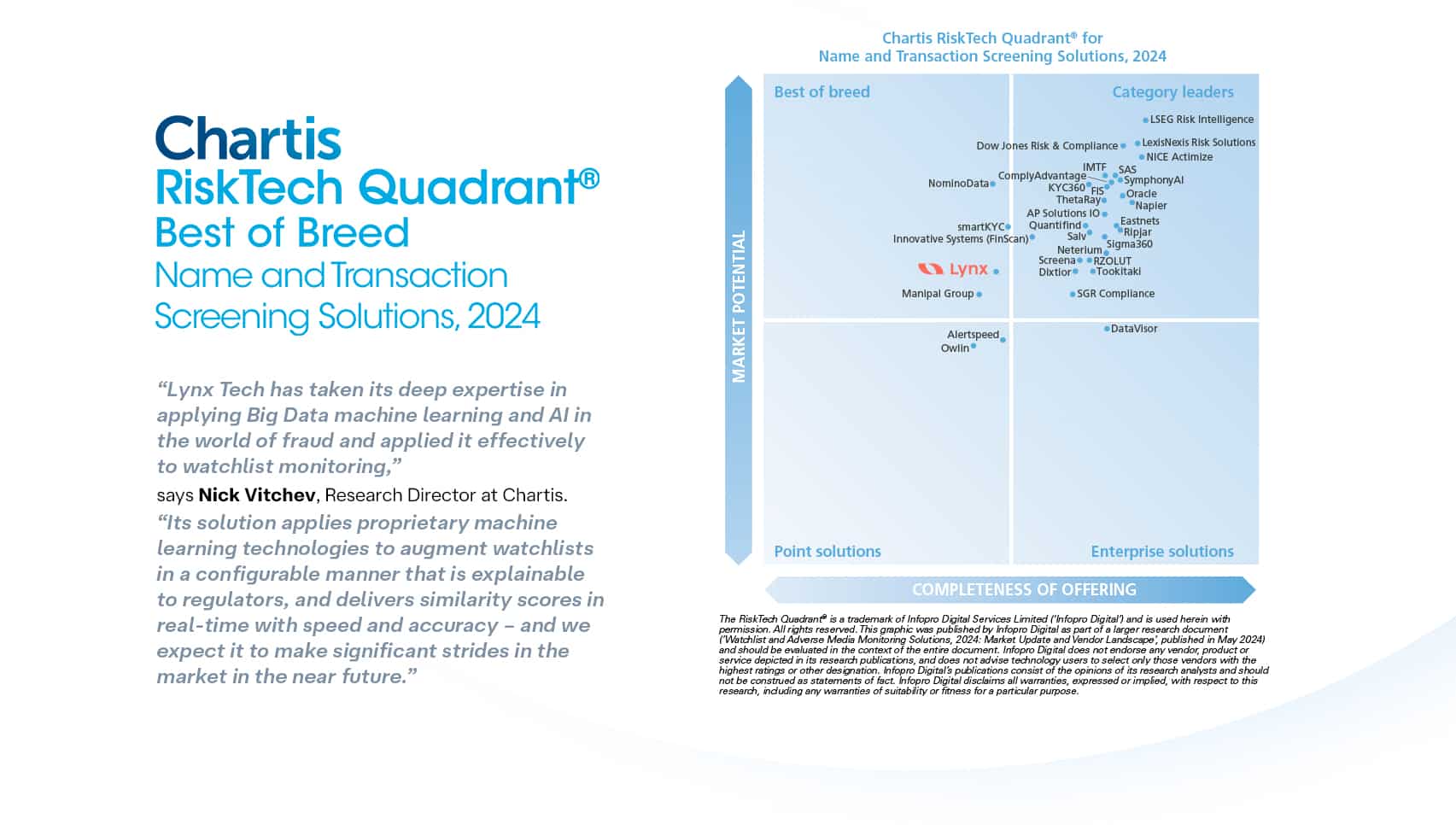
Lynx Ranked Best of Breed in 2024 Chartis
“Lynx Tech has taken its deep expertise in applying Big Data machine learning and AI in the world of fraud and applied it effectively to watchlist monitoring,” says Nick Vitchev, Research Director at Chartis. “Its solution applies proprietary machine learning technologies to augment watchlists in a configurable manner that is explainable to regulators, and delivers similarity scores in real-time with speed and accuracy – and we expect it to make significant strides in the market in the near future.”
“Lynx’s appearance in our inaugural FCC50 ranking reflects an ability to transition its knowhow and standing in the area of fraud detection into AML and beyond. Alongside a robust platform that incorporates a large number of risk signals and enables high scalability and flexibility, Lynx’s sophisticated models and tuning capabilities, underpinned by an AI-first approach, enable it to solve challenges in some of the most complex use cases and markets.”
“We’re proud to have received two forms of recognition for our solution from Chartis Research in the past couple of months. These accolades represent our commitment to remaining vigilant, agile, and customer-focused, leveraging technology to deliver innovative solutions that address the dynamic requirements of sanctions screening and AML.”
“Incredibly proud that Lynx Tech’s AML solution suite has been recognized by Chartis,” adds Alyssa Iyer, Head of Product for AML. “This acknowledgment highlights our dedication to reshaping compliance and financial crime prevention with pioneering AI technologies.”
About Lynx
Lynx is an AI-driven software company designed to solve clients’ most significant fraud and financial crime challenges. Our solutions utilize advanced AI technology to proactively identify and prevent fraud and financial crimes in real time, setting new standards for accuracy, speed, and scalability across multinational organizations. Lynx is dedicated to helping its clients move from a reactive to a proactive response by harnessing the power of AI to illuminate risk and deliver actionable insights. Lynx continues to set the standard for accuracy, speed, and scalability for multinational financial institutions (FI) and payment providers around the globe. Learn more at https://lynxtech.comAbout Chartis
Chartis Research is the leading provider of research and analysis on the global market for risk technology. It is part of Infopro Digital, which owns market-leading brands such as Risk and WatersTechnology. The goal of Chartis Research is to support enterprises as they drive business performance through improved risk management, corporate governance, and compliance, and to help clients make informed technology and business decisions by providing in-depth analysis and actionable advice on all aspects of risk technology. RiskTech Quadrant®, RiskTech100® and FinTech QuadrantTM are registered trademarks of Infopro Digital Services Limited (https://www.chartis-research.com).Money Mule Detection
Where Fraud, AML, and Cyber Intelligence Converge
Lynx Money Mule Detection uses supervised machine learning to identify illicit sources of funds and mule accounts in real-time. Allowing you to take immediate action to mitigate mules and block APPF incoming.
How Banks Can Safeguard Customers From Romance Fraud.
IWD 2024: Eradicating Industry Bias and Elevating Women
Key Insights from ACAMS Hollywood 2024
In April, industry professionals from around the globe converged at the ACAMS conference in Hollywood, a gathering known for setting the agenda in the Anti-Money Laundering (AML) realm. This year’s event was no different, shedding light on the evolving challenges and opportunities in combating financial crime. As a product leader and ex-practitioner, I am deeply entrenched in the world of AML, risk, and compliance and felt privileged to attend and engage with practitioners and innovators alike who are trying to move the industry forward in how we approach these critical issues. I’m excited to share with you three key takeaways from this year’s conference that highlight where law enforcement, regulators and banks are focused and whereas an industry should responsibly, yet intelligently, challenge convention from a technology standpoint.
My three key takeaways:
- Focus on Cybercrime and Convergence of cyber, fraud and AML
- Cautious exploration of “AI”
- National Security
1. Convergence of Cybercrime, Fraud and AML
One refreshing development this year was the increased dialogue around cyber-enabled fraud and money laundering. Executive Associate Director of US Homeland Security Investigations (HIS), Katrina Berger, emphasized the significant focus on interdicting money mules using synthetic identities as a key focus for HSI. Berger noted that Chinese Transnational Criminal Organizations (TCOs) are using counterfeit passports and IDs, including synthetic identities, to deposit massive amounts of cash, showing indifference towards the filing Currency Transaction Reports (CTRs) or Suspicious Activity Reports (SARs). This underscores the urgent need for more effective methods to proactively identify and combat these organizations. As mentioned in panels discussing fraud prevention and stopping money mules, the strategy starts with moving beyond reliance on Customer Identification Programs (CIP) for fraud prevention. Instead, incorporating biometric identification and liveness checks into the Know Your Customer (KYC) process is crucial to deter these criminals before they infiltrate the financial system. As mentioned by David Szuchman, Head of Financial Crime at PayPal, “CIP is not a fraud control…the identity piece is where it starts.” This panel stood out as one of the conference’s most enlightening, merging perspectives from law enforcement, government, industry and technology. It underscored the necessity of targeting financial crime through a holistic view of crime. In response to a question on how we can start to slow and prevent fraud, panelists agreed that fraud is not just occurring in the silo of fraud; therefore, we must be combining efforts in cyber, fraud and AML. Jill Adams, Strategic Engagement Lead in Financial Crimes at the FBI, captured this sentiment (and I’m paraphrasing here): “We’re witnessing a convergence in crime types and perpetrators – from cartels engaging in fraud to terrorist organizations financing their activities using fraudulent proceeds. We cannot afford to view fraud in isolation. We must consider the entire spectrum of criminal activity.” Another insightful takeaway was the misuse of products by criminals. Financial Institutions (FIs) need to understand the risks associated with their products and how they can be exploited. Involve product in discussions around AML and fraud prevention and give the intended product uses to investigators, so that they can spot when a product is being used in a nefarious manner. Combining insights from cyber, fraud, and AML was a clear priority for law enforcement, but inconsistencies remained across US and LatAm FIs. When asked about how FIs address money mules, the response ranged from “not an issue” to recognition of the challenge but limited tools to identify and report these criminals.2. Cautious Exploration of AI
There was recognition in the fraud prevention space that FIs cannot rely on rules-based systems and must embrace AI to stop fraud in real-time, yet palpable caution in its application within AML contexts. First, a clear distinction between AI, machine learning (ML) and Robotic Process Automation (RPA) is necessary. I heard a lot of mention of the application of “GenAI” in fraud prevention and AML, which addresses different use cases from the likes of big data AI and machine learning, for example. I would encourage ACAMs to offer a 101 on technology trends – for example, different AI methodologies in fraud prevention and AML and best practices for adoption – where practitioners and regulators are brought together to present and attend. Education about technology trends can significantly reduce fear and apprehension. Supervised machine learning, for instance, is not a black box and can considerably enhance AML efforts. Panelists across the conference were rightly concerned with how FIs prepare data to be used in machine learning – for fear of missing suspicious activity or inappropriately using biased data sources, but can we change the narrative from concern with missing something by applying technology, to concern that if we don´t use technology and diverse intelligence sources that we equally are missing the boat? Data preparation, collaboration across departments and appropriate planning are all necessary steps for implementing innovative technologies. But let´s not let it keep us from advancing as an industry. Second, FIs expressed the need for feedback from government entities on what IS suspicious (e.g. feedback on SARs), before we can train models to use in AML Transaction Monitoring systems. While I agree this feedback is long overdue from law enforcement, it should not halt us from the pursuit of innovative approaches to identifying crime. There are other intelligence sources that can inform on illicit activities. Leveraging intelligence from cybersecurity (is the IP used by the transacting customer associated with others?) or fraud investigations (has the account, IP, or device been associated with other fraud cases?), can provide crucial insights. As we tell our investigators, we need to work smarter, not harder. And it starts with leveraging the intelligence at our disposal. I would push the industry to challenge ourselves by leveraging intelligence other than government SAR data, whilst also pushing FinCEN to share SAR feedback. As Jill Adams pointed out, “Fraudsters operate at the speed of money, whereas law enforcement operates at the speed of law.” We need to work smarter and faster, with technology as a key enabler.3. National Security
The nexus between anti-financial crime measures and US national security was a central theme at ACAMs this year as well. With the US Dollar underpinning the global economy, it was clear that compliance is not simply a “check-the-box exercise”; it is a matter of foreign policy and national security. Nation-state actors aim to acquire advanced US technology to advance their military capabilities and upset the balance of power. Anti-financial crime strategies play a pivotal role in preventing sensitive technologies from falling into adversary hands through export control screenings and monitoring transactions for dual-use technology exports. Moreover, these adversaries often mask their identities to not only launder funds, but also to invest in US companies using fake companies and synthetic identities. As mentioned by Joshua Fruth, law enforcement focuses on preventive targeting – denying revenue generation – as well as forensic identification. As an industry, we must also prevent these actors from infiltrating our financial system through improved onboarding technologies, as well as better use of intelligence from across the organization. The 2020 AML Act mandates that FIs incorporate the national security priorities: corruption, cybercrime, foreign and domestic terrorist financing, fraud, transnational criminal activity, drug trafficking organization activity, human trafficking and human smuggling and proliferation financing. These national security priorities can only be effectively achieved by breaking down silos and embracing technology judiciously. ACAMS Hollywood 2024 wasn’t just another event in the calendar of financial crime and compliance gatherings; it was a clarion call for the industry to adopt a more integrated and technologically advanced approach to fight against money laundering, fraud, and cybercrime. As we reflect on the insight and foresight shared by experts, it’s clear that the road ahead requires us to break down silos and embrace innovation—whether through the judicious application of AI in AML or rethinking our strategies in light of national security concerns. The journey towards integrating AI into AML practices, understanding the amalgamation of cybercrime, fraud, and AML, and acknowledging the intrinsic connection between anti-financial crime efforts and national security, signifies a pivotal shift in the industry. As we forge ahead, equipped with fresh perspectives and a fresh determination, let us remember the collective challenge it will be to harness technology responsibly while fostering a culture of innovation and collaboration among stakeholders. Together, let’s move towards a future where financial security and integrity are not just ideals but realities. The time to act is now.Dan Dica, chief executive officer at Lynx
Money Mules – Where Fraud and Cybersecurity Converge
Introduction
In an age defined by rapid technological advancement, we are concurrently experiencing a notable surge in attacks targeting customers in the financial services sector. The complexity, diversity, and sophistication of these attacks are also on the rise. These attacks can result in mass identity theft and synthetic identity account openings, hard-to-identify social engineering schemes, such as business email compromise and authorized push payment (APP) scams, among many others. The proliferation and the magnitude of the issue has been exacerbated by several recent developments:- Criminals leverage AI advancements to orchestrate more sophisticated attacks with minimal resources, utilizing bots and social media to amplify their reach.
- Real-time payments have allowed these criminals to move illicit proceeds at an unprecedented pace without detection.
- Digital onboarding aims to provide a seamless entry process for identification and verification (ID&V); however, it has facilitated the proliferation of mule account creation.
- Embedded finance presents a valuable opportunity for diversifying products and enhancing user experience by integrating financial services within social media platforms. This convergence fosters a more seamless user experience but diminishes the inherent defense mechanisms that users rely on solely within the context of traditional banking interactions.
- Exploiting the risk-averse nature of the financial services industry, criminals capitalize on limited information sharing between banks and compartmentalized approaches by cyber, fraud, AML, and KYC teams, allowing them to perpetuate these schemes on a massive scale.
The intersection of cyber, fraud, AML and KYC…
In our view, the phenomenon of money mules is not solely a fraud issue or an AML issue. It transcends individual threat vectors, encompassing cyber, KYC, fraud and AML considerations:Cyber:
- Weak cybersecurity controls create opportunities for cybercriminals to access sensitive personal information, leading to identity theft incidents.
- Crime as a Service (CaaS) lowers technical barriers of entry for would-be attackers and illicit nefarious services such as fake identity creation, bot generation, automated phishing and vishing, fake identity document creation, and so on.
KYC:
- Criminals and money mules exploit compromised credentials to open accounts across financial institutions, often using AI-altered documentation to get through traditional KYC identification & verification customer onboarding processes. These altered and compromised credentials are incredibly difficult to spot with the human eye, proven by the estimate that 95% of synthetic identities are not detected during the onboarding process. [2]
Fraud:
- Social engineering scams manipulate individuals into willingly divulging their personal data and convince victims to send money to criminal enterprises. With the advancements in AI, social engineering is becoming increasingly more common and effective. 98% of cybercrime was found to involve some sort of social engineering. [3]
- Once mules successfully onboard, they either act immediately to start transferring fraudulent funds OR lay dormant for days, months, or years before engaging in fraudulent activities.
- Typically, fraud tools look at outgoing transactions and digital interactions, so they do not necessarily detect dormant accounts. Legacy solutions also don’t use digital signals at onboarding and cannot necessarily see how criminals are propagating their attacks.
- Mass account takeover allows criminals to gain access to a network of money mule accounts, which can be challenging to detect until after an attack has occurred, as the account behavior appeared normal until a certain point.
AML:
- The mule receives and sends transactions of varying amounts from and to other mule accounts at different financial institutions to further obscure the money trail.
- Without machine learning algorithms, it is difficult to detect in real-time that these transactions are fraudulent proceeds derived from criminal acts.
- As shown in Figure 1 [4], the nature of these transactions can be low-dollar or low-frequency, meaning AML transaction monitoring (“TM”) rules may not trigger. Without additional parameters to signal potential concerns with these accounts, solely relying on transaction amount or frequency makes it difficult to discern whether these activities signify money mule involvement.
- If AML investigators knew this was mule activity, they could immediately block and report these transactions as suspicious and identify the surrounding mule network to stop the criminal network from hurting other victims.
Figure 1: Example of how fraudulent funds are distributed using mule networks
… may bring these teams together
How do we solve this multifaceted problem? By bringing together intelligence from the different disciplines and threat vectors. Cybersecurity and fraud teams have started to converge at some forward-thinking financial institutions (FIs) because these institutions have seen the benefits that can come from intelligence sharing across these threat vectors, resulting in the emergence of a united team known as cyberfusion. The same convergence goes for AML and KYC. While money muling equates to money laundering, traditional AML strategies alone will not effectively deter these criminals. To effectively prevent money mules from infiltrating the FI, the focus should begin with the interception at the first interaction with the bank – at customer onboarding and protecting against account takeover. FIs should leverage advanced technologies for verifying customer-provided documentation and data and pinpointing counterfeit docs; confirming genuine human identity through biometric verification and liveness checks; and cross-referencing customer information with trusted data sources using automation. In addition to applying advanced technologies to confirm the prospective customer´s identity, banks, fintechs, and neobanks alike need to be asking the right questions when onboarding customers to spot unusual activity in the future – e.g. salary, source of funds, expected activity, physical address.
From Unwitting Participants to Enablers| How a bank account ends up in the hands of mule herders
In the shadowy world of financial crime, money mule refers to someone who, either knowingly or unknowingly, allows their bank account to be used to move illegal funds. Here’s how an account might find its way to a mule herder:- Knowingly Participating: Some individuals are aware they’re part of a criminal network, performing high-risk, low-reward tasks. This can involve opening multiple bank accounts, now more easily done online using real or fake information.
- Unwittingly Compromised: Others might be unknowingly roped in, such as students offered quick cash to lend their account for a weekend. By Monday, their account is back in their hands, no questions asked.
- Digital Dangers: The advent of digital banking has made it easier for criminals to use stolen data or synthetic identities to conduct their illicit activities leveraging ATO. This evolving landscape of money muling underscores a stark reality – the fight against financial crime is not solely about technology but understanding the human vulnerabilities that technology seeks to exploit. Understanding the risks and staying informed can help protect against becoming an unwitting participant in these schemes.
Conclusion
In conclusion, to proactively combat the expansion of criminal networks facilitated by money mules, firms in financial services must first and foremost effectively use threat intelligence across cybersecurity, KYC, fraud prevention, and AML. Criminals do not operate in siloes and neither can FI’s. That is easier said than done. As former practitioners, we understand that. That is why we build technologies that bring together intelligence across disciplines, without requiring that these teams be fully integrated. With that said,“…it is extremely important that financial services firms start to change the mindset in their organizations to emphasize the benefit that shared intelligence can bring. Cyber, fraud, KYC, and AML are all inextricably linked…”