Card Fraud
Lynx Fraud Prevention Wins Top Spot at FSTech Awards
The Mercurial Fraud and Financial Crime Landscape
Financial institutions (FIs) grapple with complex, interconnected fraud and financial crime challenges. Real-time payment channels and transactions facilitate seamless economic activity and enhanced customer experiences but also bring real-time threats. Organized crime groups target FIs and their customers, adapting attack methods across payment channels to bypass fraud detection systems, with authorized push payment fraud (APPF), account takeover (ATO) fraud, and AI-enabled deep fake scams. The scale and volume of fraud are enormous: global fraud losses exceeded $485 billion in 2023, with $3.1 trillion in illicit funds flowing through the global financial system. Static and inflexible fraud prevention solutions are no longer sufficient. Adaptable, real-time fraud detection is essential for FIs facing mercurial real-time threats.Staying a Step Ahead of Fraudsters with Daily Adaptive Models and Lynx Flex
Lynx’s award-winning Fraud Prevention Solution is powered by Daily Adaptive Models (DAMs), machine learning models that update daily with the latest transaction and fraud data to deliver highly accurate real-time detection even as payment methods and fraud patterns change. DAMs analyze hundreds of thousands of data points in milliseconds, enriching transactions with proprietary feeder data from onboarding and customer accounts for a comprehensive view of transactions, channels, and users. Trained using supervised machine learning algorithms, our models learn from prior fraud cases for enhanced detection accuracy with fewer false positives. DAMs are highly flexible and configurable to meet the ever-evolving fraud landscape, tailored to each FI’s transaction environment and risk appetite for optimized risk scoring. Lynx Flex empowers FIs to add new payment channels in under 60 minutes, propagating new data fields to models, rules, and reports for comprehensive multi-channel fraud detection. The results are clear. Our clients, including Santander UK, Cielo, and BCP Peru, experience an average 80% Fraud Value Detection Rate (VDR) at fewer than 10 false positives per 10,000 transactions, and 99.99% of transactions are processed in ~50ms*. Lynx’s speed, accuracy, and flexibility drive millions in fraud savings annually per institution.Customer Success Founded on Dedication, Trust, and Collaboration
Technology is only successful with the right group of people to develop, utilize, support, and adapt it. Lynx’s market leadership in fraud prevention is rooted in both artificial intelligence and human intelligence: innovative AI models paired with a dedicated, collaborative team of industry and academic experts in AI and fraud prevention. The Lynx team works closely with customers to develop partnerships founded on trust, addressing their most pressing challenges. Whether we’re addressing emerging fraud threats for issuers, acquirers, retail banks, or corporate and investment firms, we take a hands-on approach to deliver tailored and comprehensive real-time fraud detection across key channels for each company.Pioneering the Future of Fraud and AML, Together
Looking to the future, Lynx remains dedicated to developing cutting-edge AI technologies that safeguard global financial services. We will continue to address real-time threats with real-time detection- from fraud prevention to financial behavior analysis for money mule detection to AI-powered AML name screening -informed by customer trust, transparency, and partnership. As we build towards our pioneering vision of an integrated fraud and AML platform, we’re honored to work alongside exceptional global organizations who are protecting the integrity of the global financial system. Together, we will revolutionize the fight against financial crime.* Known performance where connection is TCP/IP socket and the solution is on-premise
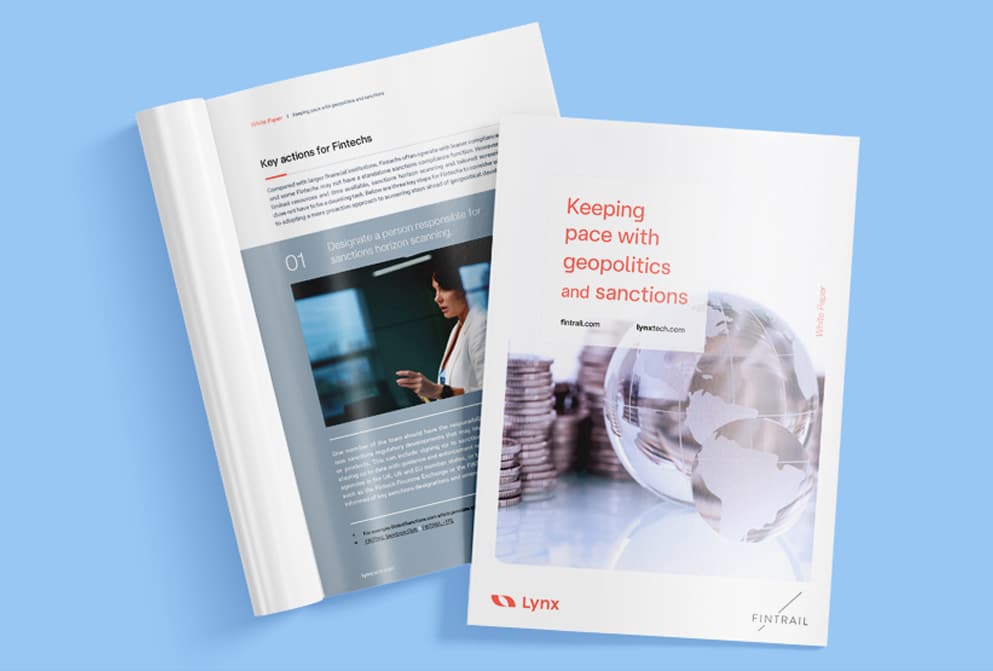
Master Sanctions Screening!
Shifting the Mindset from Cost Center to Revenue Generator
Industry reacts as UK Government axes payment watchdog.
Why corporate money mules are flooding the UK
Tackling Fraud in 2025
AI is in the pockets of criminals
Criminals are using AI to create incredibly realistic and convincing fake profiles online. The technology is leveraged to create photo-realistic identities, communicate in any language and develop personalised messages used for manipulation. This sophisticated use of AI renders traditional methods of detecting fake profiles largely ineffective, making it unrealistic to rely solely on end users to identify and prevent these attacks. Deepfake technology can make calls appear authentic, presenting criminals as the individuals they are impersonating. Five years ago, if you were speaking to a friend who had met someone online but never spoken to them on the phone or met them in person, concerns would be raised. Today, scammers speak to their victims on the phone and on video calls, nurturing deep, intimate relationships over months, or even years. The AI technology they use can enable them to bypass identity verification processes. They may employ techniques such as “injection stream attacks,” which involve inserting malicious data or code to deceive systems into accepting fraudulent inputs. Or they might use straightforward methods, like a phone app, to alter their appearance and resemble someone else. The technology also enables criminals to have more time to scale operations and scam hundreds, even thousands, of individuals at the same time. These AI-generated interactions make it even easier to build emotional connections online, often leading victims to trust and eventually send money to scammers. Banks are now mandated to pay victims back up to £85,000 but for fraudsters, this is a win, win. Not only is committing these crimes relatively easy, but criminals also know victims are likely to recoup their losses, leaving financial institutions to bear the brunt of the financial burden.Adapting new models to tackle fraud
To date, banks have typically used static fraud prevention models, which are trained once and then used for a long period of time without being updated. This approach is limited as they are unable to keep up with an ever-changing fraud pattern, which criminals know and rely on. Banks need to evolve and find new ways in which they can fight the fraudsters. With Daily Adaptive AI-driven Models, financial institutions can monitor spending behaviours and identify suspicious activity, keeping one step ahead of the scammers. By analysing hundreds of thousands of data points – from the location of the receiving bank account to the erratic nature of the payment made in an app – Daily Adaptive Models can identify and prevent fraudulent transactions in less than a second. The rapid evolution of fraud tactics necessitates a paradigm shift in fraud prevention. Static models are no longer sufficient. Daily Adaptive AI-driven models offer real-time detection capabilities, analyzing hundreds of thousands of data points to identify and prevent fraudulent transactions in less than a second. To effectively combat AI-driven fraud, financial institutions must adopt AI-powered solutions that continuously learn and adapt, keeping them one step ahead of the ever-changing landscape of financial crime.From Cost Center to Revenue Generator
Alyssa Iyer | Head of Product – AML
The first panel at FINTRAIL’s FFECON dived into the challenges of managing financial crime in an integrated ecosystem, shedding light on key strategies and considerations for fintechs and financial institutions (FIs) alike. The discussion underscored how the proliferation of financial products and the deepening collaboration between FIs and fintechs have enhanced user experiences but simultaneously introduced new risks that bad actors may exploit. With multiple entities involved in a single transaction, transparency can be compromised as crucial data gets lost along the way. By the time a payment reaches it, an acquirer may lack the necessary details to determine its legitimacy, making it highly dependent on upstream fintechs and banks. This blog post explores how fintechs can shift their compliance mindset from being costly to strategically advantageous, leveraging strong AML and fraud prevention controls to build trust, scale efficiently, and enhance business opportunities.
This growing complexity in the payments ecosystem creates a difficult dilemma for payment acquirers: should they continue processing transactions that could be fraudulent and risk their reputation, or should they sever ties with entities that shift the burden onto them? The rise in scams and money mule activities makes it imperative for fintechs, payment service providers (PSPs), and banks to assess potential vulnerabilities before entering partnerships. Banks, in particular, need to evaluate fintechs and PSPs to understand the risks introduced by their products and take necessary mitigating actions. Conversely, fintechs have a significant opportunity to strengthen their relationships with banks by demonstrating a deep understanding of product, geography, and customer-specific risks and consequently implementing robust controls. By doing so, fintechs can build confidence with banks, positioning themselves as trustworthy partners capable of managing risk effectively.
However, to successfully scale, fintechs must move beyond ad-hoc risk management and adopt a structured approach to identify and mitigate risks. While manually reviewing sanctions alerts may be feasible in the early days with a limited customer base, this approach becomes operationally risky and inefficient as the business grows. To maintain efficiency, fintechs must establish anti-money laundering (AML) and fraud prevention frameworks that incorporate recurring risk assessments across their business lines. These frameworks should define acceptable and unacceptable risks, as well as the mechanisms to manage them effectively.
Beyond frameworks, fintechs must also implement flexible, intelligent AML and fraud detection systems that align with their risk appetite. Configurable solutions allow fintechs to tailor risk-based approaches, applying higher thresholds for lower-risk products while maintaining the agility to adjust quickly if risks evolve. The era of hard-coded SQL-based policies is over;today’s fintechs need dynamic rule-setting capabilities accessible via user interfaces, enabling them to keep pace with an ever-changing threat landscape. Regulatory bodies should also be engaged in this journey to ensure risk-based strategies are sustainable and effective.
For smaller compliance teams (typical of growing fintechs), the ability to consolidate risk intelligence is crucial. Siloed systems that separately manage sanctions alerts, fraud alerts, and AML transaction monitoring (TM) alerts create inefficiencies and gaps in risk detection. If a customer triggers an alert for suspicious AML behavior, it’s critical to know whether they have previously triggered fraud alerts, as this could indicate laundering fraudulently obtained funds. Consolidating intelligence onto a single platform reduces costs associated with multiple vendors, streamlines workflows, and enhances risk identification, allowing teams to focus on higher-value risk mitigation efforts.
At an industry level, improving payment transparency and intelligence sharing is paramount to combating fraud and disrupting money mule networks in real time. While customer-centric innovation remains a priority, it should not come at the expense of enabling criminals to exploit systemic vulnerabilities. Financial services firms must foster a culture of heightened expectations around fraud and AML controls when forming partnerships. Key considerations should include: does the potential partner fully grasp the fraud and AML risks? What controls has it implemented? Will these controls scale effectively as the firm grows? And what data-sharing mechanisms are in place to uphold compliance obligations with other partners? The answers to these questions should directly inform risk assessments and partnership decisions.
For fintechs and PSPs aiming to establish strong financial services partnerships, implementing robust controls and systems is not just a regulatory necessity – it is a competitive advantage. Trust is a currency in the financial ecosystem, and by demonstrating a proactive approach to risk management, fintechs can position themselves as invaluable partners. Compliance should no longer be viewed as a cost center but rather as a strategic enabler that enhances both the bottom line and the top line. By fostering trust and transparency, fintechs can drive business growth while ensuring the financial ecosystem remains resilient against emerging threats.
Please contact me with your comments and feedback. I’m always happy to share Lynx’s approach to AML.