
Card Fraud
Don’t be duped by AI cupid: Stay alert for romance scams this Valentine’s
Banks to fraudsters: this romance is over
How Olivia tried to steal my money

By Greg Hancell, Head of Fraud Prevention, Lynx
The 2023 Norton Cyber Safety Insights Report, found that more than one in every four adults has fallen victim to an online dating or romance scam globally. As we see a significant rise in romance and investment scams around the world, we are also seeing a rise in people suffering significant financial losses, heart break, and in some devastating cases, loss of life.
Having never used dating apps, I wanted to try my own investigation and understand how the scams are taking place on dating apps, versus, the scams that take place on platforms such as Facebook or Instagram.
According to TSB, over 80% of scams originate from Facebook, therefore Meta is both a transient communication channel and an originating channel for the scammers. However, with this in mind, I wanted to delve deeper into the world of dating…and find out how romance scams can start on dating apps.
 In addition, every conversation started with them being new to the city or living in another city and wanting to meet someone to have fun and explore. And very, very quickly one of the conversations turned to an investment opportunity.
As I understand it, one Olivia who I was talking to, was buying a house. And she wanted investment. I quickly asked more questions, which led her to leaving the conversation and blocking me.
In addition, every conversation started with them being new to the city or living in another city and wanting to meet someone to have fun and explore. And very, very quickly one of the conversations turned to an investment opportunity.
As I understand it, one Olivia who I was talking to, was buying a house. And she wanted investment. I quickly asked more questions, which led her to leaving the conversation and blocking me.
 So having subscribed to a dating app, where I had spent hours completing a profile, swiping left and right, I was gifted with a conversation with five criminals and no genuine people. Really disheartening and potentially life shattering for innocent people searching for love.
It dawned on my why, one of the key features of dating sites is to match new people. The algorithms are rewarded for driving up views and amplifying new customers of the dating app. This is deliberate to secure a longer-term customer and potentially a subscription.
Unfortunately, this has the unintended outcome of amplifying the new customer to the dating site and the experienced social engineer’s new profile. Also, the new customer is given a status symbol “new to site”. This means that when you’re most vulnerable and learning about dating apps / online dating you’re more likely to match with a criminal who knows you are new to the site.
Given this outcome, it got me wondering why more is not done by dating apps to stop fraudsters using their platforms to scam those just looking for love.
So having subscribed to a dating app, where I had spent hours completing a profile, swiping left and right, I was gifted with a conversation with five criminals and no genuine people. Really disheartening and potentially life shattering for innocent people searching for love.
It dawned on my why, one of the key features of dating sites is to match new people. The algorithms are rewarded for driving up views and amplifying new customers of the dating app. This is deliberate to secure a longer-term customer and potentially a subscription.
Unfortunately, this has the unintended outcome of amplifying the new customer to the dating site and the experienced social engineer’s new profile. Also, the new customer is given a status symbol “new to site”. This means that when you’re most vulnerable and learning about dating apps / online dating you’re more likely to match with a criminal who knows you are new to the site.
Given this outcome, it got me wondering why more is not done by dating apps to stop fraudsters using their platforms to scam those just looking for love.
Looking for verified love
The first thing I did in my quest to find the scammers was to create a profile in a dating app. Like many looking for love, I entered my likes, some simple information about me such as my age, location, country of birth and what I am looking for. As someone new to dating apps, I was unaware of the significant difference between verified accounts and unverified accounts. A verified account is one where identification of that person has been confirmed through a specific process. They would have provided a photograph of their face within specific boundaries, taken through liveness detection (such as say a specific sentence, turn your head a particular way, blink, make a specific pose) and so forth, which would have then been verified by facial recognition. The accounts that are verified are signalled by a blue shield. An unverified account simply needs an email address, or phone number to validate the device is receiving access to the account created. This therefore means anyone with contact details can impersonate someone on the app, scraping photos from an influencer and putting down their hobbies as an example. I, as I imagine many are, was unaware of this fatal flaw. It must be said that verification is important as it shows that someone is who they say they are.How swiping almost got me scammed
After being encouraged to “swipe left” and “swipe right” to determine people that I liked on the dating app, I started to get matches from people that apparently liked me back. As someone completely new to using dating apps, it became apparent to me that all of those likes and all the people talking to me were criminals impersonating someone else. Maybe this is because I work in fraud and I speak on romance scams every day, but what also struck me were the commonalities between the profiles were as follows:- An attractive person
- Typically an influencer, which when I verified by a reverse image search, found to be true
- Typically 35 years old
- Typically called Olivia or Julia
- Quite new to the app
In addition, every conversation started with them being new to the city or living in another city and wanting to meet someone to have fun and explore. And very, very quickly one of the conversations turned to an investment opportunity.
As I understand it, one Olivia who I was talking to, was buying a house. And she wanted investment. I quickly asked more questions, which led her to leaving the conversation and blocking me.
Scammed by multiple Olivia’s
Over the coming hours a few more Olivia’s connected to me, all of them with similar photographs, age and profile data. To which I replied to them – when they asked what I did for a living – that I am an expert in financial crime prevention. Now, either this job is an incredible turn off when dating, or I had met many criminals and their fake identities.So having subscribed to a dating app, where I had spent hours completing a profile, swiping left and right, I was gifted with a conversation with five criminals and no genuine people. Really disheartening and potentially life shattering for innocent people searching for love.
It dawned on my why, one of the key features of dating sites is to match new people. The algorithms are rewarded for driving up views and amplifying new customers of the dating app. This is deliberate to secure a longer-term customer and potentially a subscription.
Unfortunately, this has the unintended outcome of amplifying the new customer to the dating site and the experienced social engineer’s new profile. Also, the new customer is given a status symbol “new to site”. This means that when you’re most vulnerable and learning about dating apps / online dating you’re more likely to match with a criminal who knows you are new to the site.
Given this outcome, it got me wondering why more is not done by dating apps to stop fraudsters using their platforms to scam those just looking for love.
So, what have I learnt?
If you or anyone you know is using a dating app, be incredibly cautious. If you connect with someone who is unverified, consider that they could be anyone on the other side of a computer. And finally, sometimes when looking for love, it may be too good to be true, if an attractive ‘Olivia’ likes you and starts telling you about her plans to move, then think twice. It might not be love. Most dating apps do not apply your filters verbatim; they use poetic license to find people close to what you want. That may mean that you think you are filtering out certain people, however you are matched with them. So even if not a scam, it might not be an appropriate match or your life long partner to be. Good luck to all and I wish you success and love!Lynx recognised in the 2024 Gartner®
MADRID, SPAIN – December 12, 2024 – Lynx, a pioneer in AI-powered fraud prevention and detection, today announced being recognized as a Representative Vendor in the Gartner Market Guide for Fraud Detection in Banking Payments. We believe, this recognition underscores Lynx’s commitment to delivering cutting-edge, adaptive AI solutions that help financial institutions (FIs) combat the rising tide of sophisticated financial crime. According to Gartner, “CIOs should use this Market Guide to understand the trends, challenges and technological developments in the continuing fight against fraudulent payments and money movements.” In our opinion, Lynx’s recognition reflects their ability to provide advanced AI Fraud Prevention solutions that accurately detect and prevent fraudulent transactions in real time across all payment channels, positioning the company at the cutting edge of payments fraud detection and prevention. As an emerging space, Payments Fraud introduces potential investment risks for buyers uncertain of the market’s direction.
The Urgent Need for Real-Time Fraud Detection
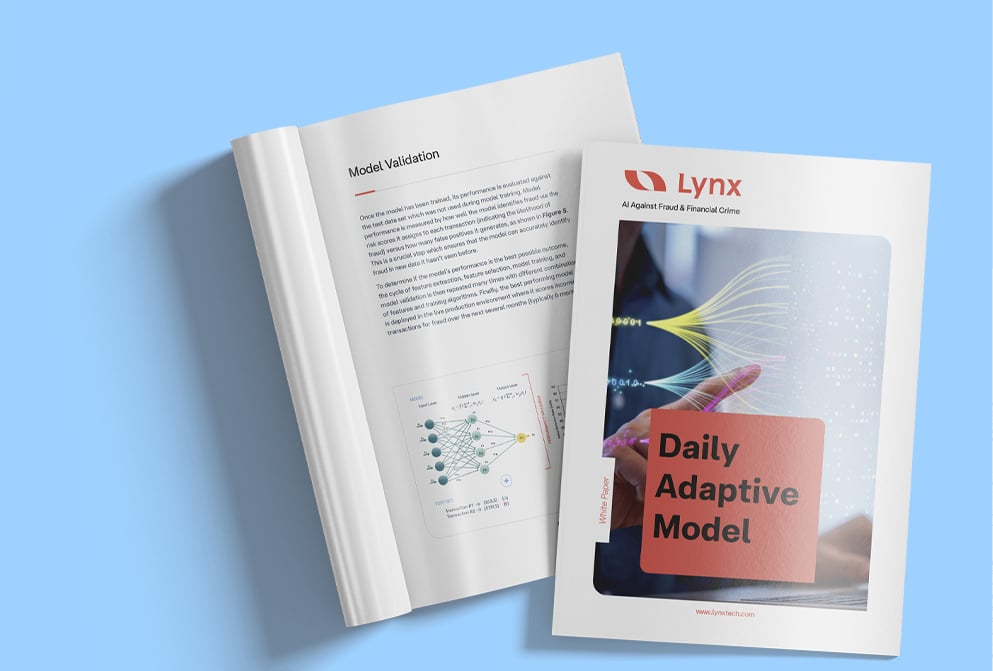
Financial crime is soaring. The 2024 Nasdaq Global Financial Crime Report reveals a staggering $3.1 trillion in illicit funds flowing through the global financial system in 2023, resulting in $485.6 billion in victim losses. Authorized push payment fraud (APPF) is a particularly significant threat, accounting for 75% of all digital banking fraud globally. Traditional rules-based systems and unsupervised machine learning struggle to keep pace with rapidly evolving fraud tactics. Lynx’s Fraud Prevention and Money Mule Detection solutions leverage their proprietary Daily Adaptive Models (DAMs) to offer a superior solution. These supervised machine learning models retrain daily, maintaining high accuracy and low false positives even as fraudsters adapt their tactics, payment technologies evolve, and users change their behaviors.
Lynx’s Innovative Approach
Lynx’s technology differentiates itself through several key features:
- Daily Adaptive Models (DAMs): These models provide real-time fraud detection with consistently high accuracy and low false positives.
- Flex: This proprietary technology enables dynamic payloads and data extensibility, allowing FIs to easily adapt to transaction types and propagate new data fields throughout the solution’s models, rules, and reports.
- Comprehensive Solutions: Lynx offers a suite of AI-powered solutions, including fraud prevention, anti-money laundering (AML), and mule detection capabilities, providing a 360-degree view of risk.
“We believe, recognition in the Gartner report validates Lynx’s leadership in AI-powered fraud prevention,” said Dan Dica, CEO of Lynx. “Our Daily Adaptive Models are setting a new standard for real-time protection.” “In my opinion, the recognition in Gartner report validates the impact of our commitment to AI innovation and customer collaboration,” said Greg Hancell, Head of Product for Fraud at Lynx. “We’re building more effective fraud prevention solutions every day.”
Download the Gartner Market Guide for fraud detection in banking payments.
Continued Industry Leadership
Lynx’s recent industry accolades, includes:
- Chartis: Leader in the 2024 Enterprise and Payment Fraud Quadrants; Best of Breed in the 2024 RiskTech Quadrant for Name and Screening solutions.
- CB Insights: Named to the CB Insights’ Fintech 100 list of most promising private Fintech companies.
- Datos: Featured in reports on Next-Gen Innovation for Scam Prevention and Q4 2024 Risk Insights & Advisory Fintech Spotlight.
Gartner, Market Guide for Fraud Detection in Banking Payments, 11 December 2024, Pete Redshaw
Gartner Disclaimer
GARTNER is a trademark of Gartner, Inc. and/or its affiliates. Gartner does not endorse any vendor, product or service depicted in its research publications and does not advise technology users to select only those vendors with the highest ratings or other designation. Gartner research publications consist of the opinions of Gartner’s Research & Advisory organization and should not be construed as statements of fact. Gartner disclaims all warranties, expressed or implied, with respect to this research, including any warranties of merchantability or fitness for a particular purpose.
About Lynx
Lynx provides cutting-edge AI-driven solutions for fraud prevention and financial crime combat, protecting more than 300 million consumers and saving clients up to $1.6 billion annually by safeguarding over 69 billion transactions. Our proprietary Daily Adaptive Model ensures unmatched accuracy and industry-leading low false positive rates. Learn more at https://lynxtech.com.
Advocating change: Women leading the tech revolution (Podcast)
Daily Adaptive Model
Navigating Sanctions in a Faster Payments World: 4 Key AML Insights

Insight 1: Reduce False Positives with High Quality Data and Advanced AI
False positives- names which are incorrectly identified as matching those on watchlists- are a widespread issue in AML watchlist screening. They often occur due to low quality data from customers or watchlists that makes it difficult to accurately match names.
Many AML vendors concentrate on developing detection methodologies like fuzzy matching- which returns names that are similar but don’t exactly match- without addressing the quality of the underlying data. In the context of faster payments and constantly evolving watchlists, this leads to more false positives and a higher investigative burden.
Addressing the False Positive Problem
Without a suite of legacy data to lean on- a common scenario for many smaller payment services providers (PSPs) and FinTechs- PagoNxt uses a variety of tools and data to reinform its screening engine, improve performance, and reduce false positives.
From the vendor side, Lynx leverages machine learning to tackle the false positive problem by first enriching watchlists with a host of name variations, creating a larger database of names to scan before cleansing and standardizing names across multiple languages and formats. Lynx’s advanced AI then calculates similarity scores in milliseconds. FIs using Lynx’s solution can customize this process based on their risk tolerance and compliance objectives, enabling quick and refined matching that lowers false positives.
Insight 2: Adapt to Changing Watchlists with Tailored List Rescreening
Another key AML challenge is effectively managing watchlist changes. Watchlists are frequently updated with new entries and updates as governments and global agencies develop new intelligence about risky customers and business entities. For example, recent sanctions against Russia in response to its invasion of Ukraine have caused numerous watchlist updates. Incorporating all watchlist changes and rescreening names after every update is a recipe for high false positives and overwhelmed investigation teams.
FIs need the ability to flexibly select which lists to screen and rescreen against. They also require capabilities to manage hits (matched names) efficiently. FIs that rely upon inflexible or outdated screening solutions are at a disadvantage here, as they can’t keep up with the pace of change.
Curated Watchlists and Rescreening
Lynx gives FIs the ability to curate watchlists and create watchlist filters specific to countries, channels, customer profiles, data types, and products, all while aligning with their compliance policies. In addition, Lynx AML’s Tailored Delta List feature allows firms to outline specific attributes that trigger rescreening. This ensures that only unique updates are received on the delta list, reducing false positives and improving alignment with each FI’s risk profile.
Insight 3: The Limitations of Rigid Systems and the Need for Real-Time Configurability
Legacy AML systems often require extensive software development and long wait times to adjust settings and integrate policy changes. This rigidity means that FIs using these systems can’t respond quickly to new risks or adjust their approach as their risk profile evolves.
More configurable screening solutions are needed in today’s ever-changing payments environment. This is particularly important for FIs offering new products and services, entering new or emerging markets, or experiencing rapid growth, as they constantly face evolving risks and need to adapt their controls.
Configurable Solutions
Fully configurable AML platforms help FIs update the watchlists they screen against, screening rules, and workflows in real time to deliver better performance. Streamlined self-service configurability is essential and helps firms respond and adapt to changing risks immediately while maintaining alignment with their risk tolerance and compliance needs.
For example, screenings of UK-based consumers and entities need to hone in on real-time authorized push payment fraud (APPF) risks given the high incidence of this type of fraud in the region, while screenings across the European Union must account for instant payments requirements and associated risks due to recent regulatory changes. FIs can use configurable solutions to quickly adapt to unique contexts, driving more accurate and compliance-aligned outcomes.
Lynx AML’s configurable watchlist management capabilities enable immediate screening changes. In addition, the solution’s case management features deliver adaptable workflows that can be updated directly from a web interface. This automates manual tasks and gives investigators more time to focus on high-impact alerts, while enabling executives to make data-driven decisions based on real-time metrics and organizational needs.
Insight 4: Use Scalable, Flexible, and Data-Agnostic Architecture to Achieve Compliance with Less Friction
FIs are screening more transaction and customer data than ever due to the massive volume of instant and cross-border payments. It’s difficult to manage so much data without slowing down the user experience, and customers often face long wait times as payment servicers investigate a growing number of false positives. FIs need solutions that accurately process data in real time to achieve compliance in a timely manner.
Scalable and Flexible Architecture
High-speed, large-volume screening demands a scalable and flexible architecture which can process thousands of transactions per second and respond immediately.
Lynx AML’s advanced AI-enabled similarity scoring matches names in milliseconds and the solution’s Watchlist Management module helps FIs tailor watchlist sources according to factors like country or business line. This flexible architecture helps firms quickly identify relevant risks in a fast-paced and high-volume transaction environment.
Data-Agnostic Interfaces
FIs also need to process cross-border payments across various data formats including ISO20022 and legacy messaging like SWIFT MT. While firms globally are moving to the ISO20022 standard, many- including Tier 1 firms- are unlikely to make the full transition by late 2025 when the format is scheduled to become the new standard.
A converter approach, whereby solutions convert incoming transactions to a standard format, can create problems including data loss and incorrect formatting. AML platforms which process various transaction formats natively offer the most streamlined approach.
Lynx’s AML solution is ISO20022 native and data-agnostic, giving FIs the ability to ingest any transaction data format. This helps firms easily update formats and accelerate their data transformation journeys.
Conclusion
As FIs take on emerging screening challenges in the age of faster payments, they must incorporate cutting-edge approaches and technologies to drive the best outcomes for financial crime detection, compliance, and customer experience. The most effective AML screening solutions:
- Utilize AI to facilitate comprehensive coverage and reduce false positives
- Offer tailored watchlist and screening methodologies to incorporate list changes without producing too many false positives
- Leverage flexible architecture and self-service configurability
- Are data-agnostic and process common transaction formats natively
Acknowledgements: Thank you to Lucy King for moderating the fireside chat and to Caroline Kennedy and Oliver Achkar for sharing their expert perspectives on key screening challenges and best practices.
Lynx AML
Lynx AML leverages advanced AI to detect financial crimes and streamline compliance operations, with core capabilities including transaction screening, name screening, and automated case management.
Interested to learn how you can improve AML detection, compliance, and operations with Lynx’s AI-driven solution? Request a demo today.
4 Ways to Stop Money Mules

4 Ways Financial Institutions Can Stop Money Mules in Their Tracks
Financial institutions (FIs) face money mule and money laundering risks due to the real-time availability of their digital products and services.- The bad news: many anti-money laundering (AML) and mule detection solutions aren’t up to the task. As a result, most FIs are unable to immediately detect and stop incoming funds from illicit sources or customer accounts which are exhibiting money mule behavior.
- The good news: there’s a better way forward. Here are 4 ways FIs can stop money mules in their tracks.
1: Use Real-Time Detection, Not Reactive Solutions
Traditional fraud prevention and AML methods are reactive and ineffective against money mules. These solutions identify and flag unusual long-term account activity associated with money laundering. With traditional methods, the goal is not to stop money laundering or muling as it happens, but rather to learn about the criminal network and share information with law enforcement for wider takedown efforts. This reactive approach allows mules to launder money unchecked, creating a vicious cycle of crime. FIs need a real-time approach to the real-time money mule problem. This is only possible with advanced machine learning (ML) models which use algorithms and techniques that accurately detect and stop muling as it’s happening. Regulatory pressures are encouraging more FIs to embrace real-time solutions. For example, since the Contingent Reimbursement Model rule change on October 7, 2024, UK-based FIs that receive scam funds now must split reimbursement costs 50/50 with sending FIs. These FIs are now incentivized to identify money mules and incoming APP fraud funds in real time to protect their customers and prevent illicit money from leaving their systems.2: Leverage Supervised Machine Learning
Fraud prevention and AML efforts often rely upon unsupervised ML models to identify money mules. These models focus on identifying unusual or atypical patterns and perform inadequately given the complexity of money laundering and muling; after all, an unusual transaction doesn’t mean the customer is a money mule. These models fail to accurately identify money mules and lead to significant losses, while inundating analysts with false positives that contribute to alert fatigue and burnout. FIs need to use supervised ML models which train with labeled data given the complexity of digital transactions and crime. Supervised learning techniques outperform unsupervised learning and enhance model accuracy as the model is trained to identify money mules specifically, thus preventing illicit funds from flowing unabated and saving millions in mule losses. This also reduces false positives, alleviating analyst workloads and improving compliance operations.3: Update Machine Learning Models Frequently
Mule detection models must quickly adapt and retrain to avoid drift and performance degradation given fast-changing criminal tactics, customer behaviors, and emerging products and technologies. Static models that retrain infrequently perform worse over time, detecting fewer mule accounts and generating more false positives. Daily adaptive models (DAMs), developed by Lynx, continuously update by retraining with new data and keep up with the latest trends in money muling. These models allow FIs to swiftly adapt to evolving criminal methodologies, payment technologies, and user behaviors.4: Train Detection Models with Non-Transaction Data and Dynamic Payloads
Most mule detection models are trained exclusively with transaction payload data. While critical, transactions only tell part of the money muling story. Any customer account can become a mule account either knowingly or unknowingly at any point in time, making account, login, and onboarding data critical to understanding mule risk. In addition, most models only analyze transactions that match the payload type they were trained with and are unable to adapt to new types of data and payment channels. This is insufficient in the ever-changing payment system environment where new data fields and payment types constantly emerge and may be relevant to detecting money muling. Lynx’s DAMs integrate diverse data sources including customer account activities and transaction histories to refine their understanding of patterns associated with money mule activities. The models accurately distinguish between suspicious and legitimate transactions, stopping mules in their tracks and preventing illicit funds from leaving the FI’s systems without blocking genuine users. The models also use Lynx Flex, which enables dynamic payloads and incorporates new data types in model training. Lynx Flex additionally allows FIs to configure API and intelligence feeds through a no-code user interface, providing data extensibility that propagates to models, rules, and reports.Read Lynx’s White Paper for More Insights
Interested to learn more about money mule techniques, global efforts to curb muling and money laundering, and how to implement cutting-edge detection solutions? Read our white paper Money Mules Revealed.Get in Touch
Ready to take the next step? Reach out and schedule a POC- no PII required.Fraud Prevention

Stop Fraud Before it Happens. Lynx offers a multi-channel, AI-driven solution that adapts to evolving fraud tactics, minimizes false positives, and protects your organization in real-time.