Card Fraud

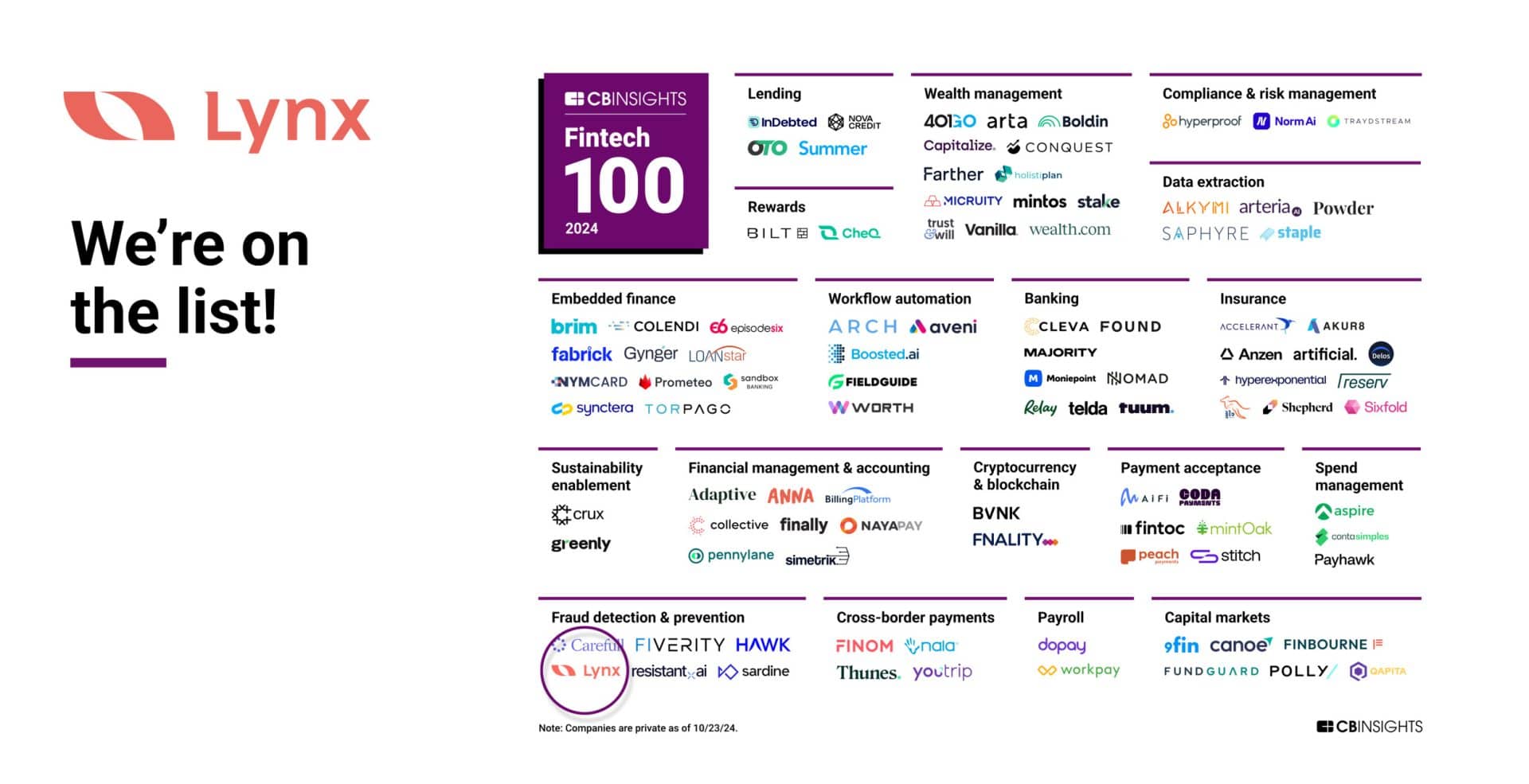
Lynx named to CB Insights’ Fintech 100

NEW YORK, October 24, 2024 – CB Insights today named Lynx Tech to its seventh annual Fintech 100, showcasing the 100 most promising private fintech companies in the world.
“The 2024 Fintech 100 winners are high-momentum companies shaping the future of financial services,” said Laura Kennedy, Principal Analyst at CB Insights. “Unsurprisingly, this year’s cohort is deploying AI across a wide variety of solutions. But they’re also diverse in their reach in emerging and developing economies, and focus on everything from fraud prevention to financial inclusion.”
“Our technology gives financial institutions the power to fight back against financial crime in real-time, using artificial intelligence to detect fraud and money laundering,” said Dan Dica, CEO at Lynx. Our recognition in the Fintech 100 reflects our relentless commitment to remaining vigilant, agile, and customer-focused on the battle against fraud. We’re proud to protect over 300 million people against fraud, each year leveraging our game-changing Daily Adaptive Model.”
The list primarily includes early- and mid-stage startups driving innovation across fintech. Our research team picked winning companies based on CB Insights datasets, including deal activity, industry partnerships, team strength, investor strength, employee headcount, and proprietary Commercial Maturity and Mosaic scores. We also dug into Analyst Briefings submitted directly to us by startups. Lynx offers a suite of solutions including Lynx Fraud Prevention, Lynx Money Mule Detection, and Lynx AML, each designed to tackle the complex challenges faced by financial institutions and payment providers. Central to these solutions is the proprietary ‘Daily Adaptive Model,’ which learns new behaviors and updates models daily, significantly enhancing risk accuracy. This innovation has saved financial institutions over $1.6 billion in fraud losses, safeguarding more than 69 billion transactions and over 300 million consumers annually. Lynx’s performance exceeds industry standards by threefold, maintaining exceptionally low false positive rates. The latest accolade follows Lynx’s recognition earlier this year as a leader in Chartis’ Enterprise and Payment Fraud Quadrants and as a Best of Breed Solution in the 2024 Chartis RiskTech Quadrant for Name and Screening solutions. Its placement in the Fintech 100 further solidifies the company’s position as a frontrunner in the financial crime prevention sector.

About CB Insights

CB Insights is an AI super analyst for market intelligence. It delivers instant insights that help you bet on the right markets, track competitors, and source the right companies. Our AI super analyst is powerful because it is built on the validated database of companies and markets that CB Insights is famous for. To learn more, please visit www.cbinsights.com

About Lynx

Lynx is an AI-driven software company designed to solve clients’ most significant fraud and financial crime challenges. Our solutions utilize advanced AI technology to proactively identify and prevent fraud and financial crimes in real time, setting new standards for accuracy, speed, and scalability across multinational organizations. Lynx is dedicated to helping its clients move from a reactive to a proactive response by harnessing the power of AI to illuminate risk and deliver actionable insights. Lynx continues to set the standard for accuracy, speed, and scalability for multinational financial institutions (FI) and payment providers around the globe. Learn more at https://lynxtech.com

Preventing Money Mules in Banking

Daniel Mcloughlin

Why prevention is better than cure with Money Mule accounts. 

As the UK enters a new phase in banking regulation, the issue of Money Mules has come into focus. For the first time, the regulators are adding liability to Payment Service Providers (PSP’s) that facilitate money mule accounts. Although this is a UK-specific regulation, its impact is expected to resonate globally as other nations observe its effects.   

What are Money Mules?

Quite simply, they are an integral part of the Money Laundering system, playing a crucial role in moving illicit funds through the banking system. Crime can generate huge amounts of money, and historically crime-generated profits were often in cash. You may have seen the huge piles of cash found at Pablo Escobar’s estate or remember the criticism of the Bank of England in 2020 for having £50 Billion in unaccounted cash. Historically, this money was laundered through “cash” businesses to legitimise it. However, in an era dominated by digital banking and digital crime, the laundering of money has shifted towards the mainstream banking system.  This is where Money Mule accounts come in. Money Mules tend to fall into three categories.  
  1. Compromised Accounts (Third-Party Fraud) Legitimate accounts belonging to individuals who have fallen victim to fraud, allowing fraudsters to gain unauthorised access and use them as conduits for stolen funds. 
  2. Recruited Accounts (First-Party Fraud) Accounts intentionally opened by individuals recruited by fraudsters. Recruits may or may not be aware of the illegal nature of the activities they are involved in.  
  3. Fake Accounts (New Account Fraud) Fraudsters may create entirely fictitious accounts using stolen or synthetic identities to serve as conduits for illicit funds. 
Detecting Money Mule activity has always been a complicated challenge due to the differing scenarios. In effect, any account could become a mule account, which means much of the detection work has been reactionary.   Therefore, real-time Money Mule detection is a vital tool in the prevention of fraud in our financial systems.  Real-time problems require real-time solutions.  

Social Responsibility 

While money mules can be found in all three categories, recruited accounts require us to spotlight them. Firstly, we need to ask how and why money mules are recruited.   This is a fascinating area, and it seems more and more people are being dragged into this illegal practice via social media. Misconceptions persist that money muling is a victimless crime, with FOMO (fear of missing out) often exploited during recruitment.   Those caught in the past might have likened their actions to something that was a little bit wrong, like minor infractions akin to sharing an MP3 or slightly speeding. Not that we should diminish petty acts of illegality, but Money Muling is actually far worse, often financing heinous crimes such as terrorism, human trafficking, and modern slavery. This unwitting involvement in serious criminal acts underscores the social responsibility of financial institutions.  Social media is awash with “Hacks” and “Glitches,” and people looking for “side hustles” are often targeted, as are those suffering from financial difficulties and often students struggling to pay bills for the first time.   With access to proactive, real-time Money Mule detection, the industry has a responsibility to leverage this money mule detection to prevent potential crimes with severe consequences. They have a social responsibility to stop those who may be about to commit a crime that could have far-reaching ramifications. Consequences include the loss of access to financial products,  potentially no access to utility contracts, and a criminal record.    While consumer education is crucial, it often fails to reach those at most risk. With accurate risk evaluation, it might be possible for banks to send targeted educational messaging to the accounts they see as most likely candidates for money muling. Even as a last resort, a real-time intervention on the first Money Muling transaction could be just what is needed to prevent a lot of recruited Money Mule crimes.  Money Mule recruits often become victims twice over, primarily from the fraudsters who recruit them and then from the criminal justice system. 

The Many Benefits 

Real-time mule detection and prevention offer numerous benefits. From the social impact to the reduced opportunities to launder money. When fully implemented and integrated, real-time Money Mule detection can benefit both fraud prevention and AML teams, demonstrating the real benefits of shared information and tools for both of these teams. Real-time fraud and real-time money mule detection gives us the tools to prevent many aspects of financial crime — truly illustrating that prevention really is better than cure.    Download our Money Mules White Paper to uncover the critical role of real-time detection in preventing money laundering and protecting those most at risk. Learn how the industry can uphold its social responsibility.  DOWNLOAD NOW   

Unlock Real-Time Fraud Detection

Financial institutions face a relentless onslaught of fraud, with authorized push payment fraud (APPF) leading the charge.  Globally, APPF accounts for 75% of all digital banking fraud, and losses are projected to skyrocket in the coming years.  In this critical environment, accurate and timely fraud detection is paramount. This white paper, developed by Lynx – a leader in AI-powered fraud prevention – explores how supervised machine learning (ML) provides the solution.  Authored by Carlos Santa Cruz, CTO of Lynx and Professor of Computer Science and Artificial Intelligence at the Universidad Autónoma de Madrid, the paper delves into the crucial aspects of building, training, testing, and deploying effective ML models for real-time fraud detection. What you’ll learn:
  • The challenges of traditional fraud detection methods: Discover why rule-based systems fall short in today’s complex digital landscape.
  • The power of supervised machine learning: Understand how ML algorithms accurately classify transactions as genuine or fraudulent.
  • The five crucial phases of ML model construction: From data preparation and feature extraction to model building and validation, learn the step-by-step process.
  • The importance of frequent retraining: Explore why Lynx’s Daily Adaptive Models retrain daily to maintain accuracy and minimize false positives.
  • The impact of model drift and how to overcome it: Discover how environmental changes and evolving fraud techniques necessitate frequent model retraining.
  • Supervised vs. Unsupervised Learning: Learn the significant performance difference between these approaches in the complex fraud detection problem.
Download the white paper today and gain a comprehensive understanding of how Lynx’s innovative technology helps financial institutions effectively combat fraud and safeguard their assets. Read the Whitepaper now

Money Mules Revealed

As organized crime groups (OCGs) continue to adapt their tactics, financial institutions (FIs) face an urgent challenge: the exploitation of vulnerabilities through money mules who launder billions of dollars each year. This comprehensive white paper, “Money Mules Revealed,” provides an in-depth examination of the evolving landscape of money laundering and the critical need for real-time detection solutions.Key Insights You’ll Gain:
  • The Role of Money Mules: Explore how money mules facilitate various types of financial crimes, including authorized push payment fraud (APPF), identity theft, and phishing, as well as their connections to physical crimes such as drug trafficking and human trafficking.
  • Types of Money Mules: Learn about the three main categories of money mules — Compromised, Recruited, and Fake Mules — and how these distinctions illustrate the ways criminals exploit financial systems.
  • Regional Dynamics: Understand how the dynamics of money muling differ across regions, particularly the regulatory changes in the UK and the rise of digital banking in Latin America, each contributing to the evolving complexities of financial crime.
  • Core Challenges for Financial Institutions: Discover the pressing issues facing FIs today, including financial losses, increased operational costs, and regulatory penalties stemming from illicit fund flows.
  • Real-Time Solutions with AI: Uncover how supervised machine learning (ML) models, particularly Lynx’s proprietary Daily Adaptive Models (DAMs), offer a transformative approach to detecting and preventing financial crimes. With real-time updates and improved accuracy, these technologies provide critical insights to mitigate risks associated with money mules.
  • Proven Results: The white paper presents real-world case studies, including how one Tier 1 banking client achieved a remarkable 65% Account Detection Rate (ADR) and a 70% Value Detection Rate (VDR) using Lynx’s DAMs, significantly reducing false positives.
Take Action Now Stay ahead of emerging trends and enhance your institution’s defenses against money laundering. Download the white paper today to access essential strategies and insights that can help your organization effectively combat money mule threats. Download the White Paper
Read the Whitepaper now

Lynx Predict a New Era for APPF Reimbursements

The PSR’s APPF Reimbursement Requirements

Lynx’s Experts Predict a New Era for APPF Reimbursements in the UK

Authorised Push Payment Fraud (APPF) continues to be a significant problem for consumers and financial institutions in the UK. The Payment Systems Regulator’s (PSR) latest data shows that in 2023 victims reported 252,626 APPF cases costing almost £341M.   The good news: there have been some improvements in APPF prevention and response since 2022. The value of APPF losses is 12% lower and reimbursement rates among Payment Service Providers (PSPs) and Financial Institutions (FIs) are higher overall.  The bad news: the volume of APPF scams is 12% higher than in 2022 and reimbursements vary significantly across payment providers. The data also shows that inbound APPF prevention (received payments) significantly lags behind outbound APPF prevention (sent payments) in most institutions.    

The PSR’s APPF Reimbursement Rules

Starting on October 7, 2024, the PSR is enforcing new APPF reimbursement rules for PSPs using the Faster Payments Service (FPS). These regulatory changes seek to curb APPF and reimburse more victims.  The rules state that APPF reimbursement will be split 50/50 between sending and receiving PSPs. There is a £85,000 maximum reimbursement per claim, a 5 business day reimbursement window and a set of reporting requirements (for a full review of the regulatory changes, read Lynx’s fact sheet here).  Several important questions arise from these new rules. How will the financial services industry adapt? How will consumers be impacted? What are the implications for preventing fraud, identifying money mules, and stopping money laundering?   Here are the top three predictions from Lynx’s team of fraud prevention and anti-money laundering experts.     

Prediction 1: Increased Investments in Fraud Prevention and Money Mule Detection

Dan Mcloughlin, Head of Pre-Sales, UK 
The high reimbursement maximum will introduce a substantial financial burden for PSPs and FIs. The PSR is signaling that these institutions must prevent the flow of fraudulent transactions or be prepared to face higher reimbursement costs. This should drive investments in stronger fraud prevention technologies and strategies, particularly those that allow real-time detection and intervention. PSPs and FIs that fail to adapt will face higher fraud losses and claims, more false positives, and reputational damage, not to mention more attacks from criminals who see an opportunity to target weaker systems. 
The 50/50 split for APPF reimbursements will also force payment providers to place a higher priority on stopping inbound fraud and money mule accounts, two areas that have lagged outgoing APPF prevention. More PSPs and FIs will invest in high-performing money mule detection and removal technologies. Uncovering more mules will ultimately help prevent money laundering, reduce the amount of fraudulent funds in financial systems, and inhibit reinvestment in criminal infrastructure.Read more of Dan’s commentary here:– paymentexpert.com– thebanker.com

Prediction 2: Better Collaboration between Fraud Prevention and Anti-Money Laundering (AML) Teams

Alyssa Iyer, Head of Product – AML 
As FIs and PSPs focus more resources on money mules and inbound APPF, there is an opportunity to bridge gaps between traditionally siloed Fraud Prevention and AML teams to prevent more financial crime. At a high level, these two groups share a goal: identifying, stopping, and reporting criminal transactions with greater precision and speed to protect consumers and businesses. When it comes to stopping money mules, the overlap is more tangible. Money mules launder fraudulently obtained funds, so both Fraud Prevention and AML teams are needed to stop mules. 
PSPs and FIs that invest in unified mule detection technologies will enable these teams to foster greater collaboration, a culture of synergy, and enhanced efficiencies. This will drive better compliance outcomes and protect more consumers and businesses. Seamless integrations between Fraud Prevention and AML will also help institutions quickly alert and assist law enforcement before the trail goes cold, catching more mules and stopping the flow of illegal funds.  

Prediction 3: Higher Demand for Adaptive AI Technologies

Greg Hancell, Head of Product – Fraud
The PSR’s new rules define a new reality for payment providers. These institutions need to comprehensively monitor all inbound and outbound transactions to detect and stop APPF and mule accounts in real time without preventing legitimate transactions. This is only possible with adaptive and flexible technology given ever-changing criminal tactics, shifting user behaviours, and emerging digital payment methods. 
In today’s transaction environment, rules-based fraud prevention alone isn’t enough. Rules must be paired with AI and machine learning (ML) models which can capture complex fraud and money muling behavioural patterns.
However, not all solutions are created equally. Static ML models which retrain only once every few months don’t keep up with evolving behaviours and technologies.PSPs and FIs will increasingly seek out ML-based fraud prevention and mule detection solutions that quickly retrain and learn from the latest criminal and technological trends whilst performing with high accuracy. 

How Lynx Money Mule Detection Can Help

Lynx has the technology to help FIs and PSPs meet the PSR’s new requirements, uncover more mules, and unify fraud prevention and AML efforts.   Lynx Mule Account Detection empowers payment providers with a 360-degree view of incoming and outgoing money mule transactions. The solution is powered by Daily Adaptive Models, supervised ML models that are retrained daily to identify fraudulent funds and mule accounts in real-time with the highest accuracy and lowest false positives. Adaptive and extensible payloads are enabled thanks to Lynx Flex, which allows PSPs and FIs to configure API and intelligence feeds in a user interface and propagate changes to models, rules and reports.   Here’s how Lynx Money Mule Account Detection works. The solution reviews incoming transactions in real-time, applies a risk score based on the likelihood of a transaction’s association with illicit funds, automatically flags and blocks mule accounts, and generates alerts for Fraud and AML teams. A unique mule score provides immediate value with proactive and dynamic data enabling faster decision-making by Fraud and AML teams. Additionally, this upstream service provides more actionable insight and confidence to transaction monitoring teams, further enhancing seamless decision-making and increasing process automation and operational efficiencies.  Lynx Money Mule Detection isn’t just a mule prevention solution: it also enables real-time AML monitoring. When money muling is identified, an immediate alert is sent to the Fraud Prevention and AML teams. This provides integrated threat intelligence to detect mules, stop fraud, and flag suspicious money laundering activity. Lynx’s solution helps payment providers stop fraudulent funds from entering and or leaving the institution, reduces false positives and operational costs, protects consumers and businesses, and defunds crime to disrupt the criminal cycle.    

Get in Touch

Lynx Money Mule Detection is available as a standalone solution or may be used in conjunction with Lynx Fraud Prevention to accurately identify fraud and money mules in outgoing and incoming transactions. To learn more, read the Lynx Money Mule Detection Guide. Lynx prevents £1.6 billion in fraud per year (rolling 12-month period). Interested to learn more? Reach out to request a demo or a proof of concept today 
 

Lynx’s no-code solutions shine in Chartis report

Dan Dica, CEO, Lynx
Efficiency is critical in the fight against financial crime. Adapting to new threats in the shortest amount of time possible has never been more important. The latest Chartis Market Update and Vendor Landscape emphasizes the growing importance of low-code/no-code configuration options in enterprise and payment fraud solutions. This shift is democratizing fraud detection and prevention, making sophisticated, market-leading tools accessible to a broader audience. Our recent recognition as a category leader in Chartis’ RiskTech Quadrant® for both Enterprise and Payment Fraud solidifies what we’ve long known: no-code is not just a trend; it’s the future of fraud prevention. 

The Importance of No-Code Solutions

No-code platforms are breaking down the traditional barriers that once limited advanced fraud detection capabilities to only the largest institutions with extensive IT resources. Now, companies across the financial spectrum can implement and adapt complex fraud prevention strategies quickly and efficiently, leveling the playing field and enhancing the industry’s overall resilience to financial crime.  The agility offered by no-code solutions is particularly crucial in today’s rapidly evolving fraud landscape. As criminals continually devise new schemes and tactics, financial institutions need the ability to respond swiftly. Reported cases of fraud are rising, and the amounts involved are getting larger. Last year, fraud losses in the UK rose to £2.3 billion, the second-largest annual fraud total in the past decade, representing a 104% increase compared to 2022 figures. Around the world, total losses were estimated at $485.6 billion, with payment fraud accounting for 80% of the total.  No-code platforms enable organizations to modify their fraud detection rules and models in real-time, without the need for extensive coding or IT intervention. Their ease of setup offers organizations unprecedented agility, improving the effectiveness of fraud prevention efforts while significantly reducing the window of vulnerability when new threats emerge. With the UK’s APPF regulation deadline approaching in October, no-code solutions offer banks the ability to seamlessly integrate AI-powered and machine-learning solutions to detect fraudulent transactions, potentially saving them hundreds of thousands of pounds in reimbursement costs.  The launch of Lynx’s Mule Account Detection solution earlier this year exemplifies this agility, offering real-time mule detection to combat the flow of illicit funds through the global financial system.   

Industry Recognition for Lynx

Our commitment to no-code innovation in fraud prevention has been recognized by Chartis, a leading provider of research and analysis on the global market for risk technology. This is a true testament to the effectiveness of our approach and the strength of our solutions.   Lynx’s positioning as a category leader in both the Enterprise and Payment Fraud quadrants reflects our ability to deliver critical fraud management capabilities, backed by strong core technology and advanced modeling capabilities. Our AI-driven approach, coupled with no-code flexibility, enables us to handle complex fraud scenarios and high transaction volumes accurately and quickly across multiple channels.  Nick Vitchev, Research Director at Chartis, highlighted our capabilities, stating:
“Lynx’s category leader position in both quadrants reflects its ability to deliver in several areas that are critical to enterprise fraud management, backed by strong core technology and advanced modeling capabilities. Alongside strong behavioral modeling and the ability to customize for complex fraud scenarios and typologies, Lynx’s modeling strength in payment fraud enables it to handle high transaction volumes accurately and quickly across a number of payment rails.” 
This recognition validates our strategy of empowering financial institutions with flexible, powerful tools to combat financial crime. It follows our recognition in May 2024 as a Best of Breed Name and Transaction Screening Solution in the 2024 Chartis RiskTech Quadrant for Name and Screening solutions, solidifying our position as a frontrunner in financial crime prevention. By making sophisticated tools accessible through no-code platforms, we’re enabling institutions of all sizes to enhance their defenses and contribute to a more resilient global financial ecosystem. 
 

Lynx Named Leader in Chartis’ Enterprise 2024

19, September 2024, London, UK:  Lynx, a leading provider of AI software for detecting and preventing fraud and financial crimes, has been recognised by Chartis as a category leader in the RiskTech Quadrant® for Enterprise and Payment Fraud.    Chartis’ latest report emphasises the transformative influence of low-code/no-code configuration options in enterprise and payment fraud solutions. This trend is democratising fraud detection and prevention, making sophisticated tools accessible to a broader market. Lynx’s focus on no-code solutions positions it well in this evolving landscape, enabling rapid adaptation to changing fraud prevention requirements.   
Nick Vitchev, Research Director at Chartis, says: ‘Lynx’s category leader placement in both quadrants reflects its ability to deliver in several areas that are critical to enterprise fraud management, backed by strong core technology and advanced modelling capabilities. Alongside strong behavioural modelling and the ability to customise to complex fraud scenarios and typologies, Lynx’s modelling strength in payment fraud enables it to handle high transaction volumes accurately at speed, across a number of payment rails.’    
By leveraging cutting-edge AI and machine learning technologies, Lynx empowers financial institutions to rapidly adapt to evolving fraud threats. The company continues to launch new agile solutions, with its recent Mule Account Detection solution offering real-time mule detection for banks and financial institutions to stop trillions of illicit dollars flowing through the global financial system each year.  
Dan Dica, CEO of Lynx, comments: “Lynx’s category leader placing in both quadrants underscores our leadership in platformisation and no-code configuration for fraud prevention. Alongside strong behavioural modelling, and the ability to customise to complex fraud scenarios and typologies, Lynx’s modelling strength in payment fraud enables it to handle high transaction volumes accurately at speed, across a number of payment rails.”  
The latest accolade follows Lynx’s recognition in May as a Best of Breed Solution in the 2024 Chartis RiskTech Quadrant for Name and Screening solutions, further solidifying the company’s position as a frontrunner in the financial crime prevention sector.   

About Lynx  

Lynx is an AI-driven software company designed to solve clients’ most significant fraud and financial crime challenges. Our solutions utilize advanced AI technology to proactively identify and prevent fraud and financial crimes in real time, setting new standards for accuracy, speed, and scalability across multinational organizations.   Lynx is dedicated to helping its clients move from a reactive to a proactive response by harnessing the power of AI to illuminate risk and deliver actionable insights. Lynx continues to set the standard for accuracy, speed, and scalability for multinational financial institutions (FI) and payment providers around the globe.